
Kardi Teknomo
Kardi Teknomo Kardi Teknomo Kardi Teknomo
   
 
  Research
  Publications
  Tutorials
  Resume
  Personal
  Contact

Visit Tutorials below:
Adaptive Learning from Histogram
Adjacency matrix
Analytic Hierarchy Process (AHP)
ArcGIS tutorial
Arithmetic Mean
Bayes Theorem
Bootstrap Sampling
Bray Curtis Distance
Break Even Point
Chebyshev Distance
City Block Distance
Conditional Probability
Continued Fraction
Data Analysis from Questionnaire
Data Revival from Statistics
Decimal to Rational
Decision tree
Difference equations
Digital Root
Discriminant analysis
Divisibility
Eigen Value using Excel
Euclidean Distance
Euler Integration
Euler Number
Excel Iteration
Excel Macro
Excel Tutorial
Feasibility Study
Financial Analysis
Generalized Inverse
Generalized Mean
Geometric Mean
Ginger Bread Man and Chaos
Graph Theory
Growth Model
Hamming Distance
Harmonic Mean
Hierarchical Clustering
Independent Events
Incident matrix
Jaccard Coefficient
Kernel basis function
Kernel Regression
k-Means clustering
K Nearest Neighbor
LAN Connections Switch
Learning from data
Lehmer Mean
Linear Algebra
Logarithm Rules
Mahalanobis Distance
Market Basket Analysis
Mean Absolute Deviation
Mean and Average
Mean, median, mode
Minkowski Distance
Minkowski Mean
Monte Carlo Simulation
Multi Agent System
Multicriteria decision making
Mutivariate Distance
Newton Raphson
Non-Linear Transformation
Normalization Index
Normalized Rank
Ordinary Differential Equation
Page Rank
Palindrome
PI
Power rules
Prime Factor
Prime Number
Q Learning
Quadratic Function
Rank Reversal
Recursive Statistics
Regression Model
Reinforcement Learning
Root of Polynomial
Runge-Kutta
Scenario Analysis
Sierpinski gasket
Sieve of Erastosthenes
Similarity and Distance
Solving System Equation
Standard deviation
Summation Tricks
System dynamic
Time Average
Tower of Hanoi
Variance
Vedic Square
Visual Basic (VB) tutorial
What If Analysis


Understanding Pattern of Digital Root

By Kardi Teknomo, PhD.

<Previous | Next | Contents>

Consider the following multiplications
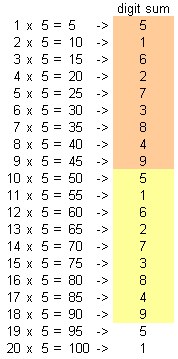
You see the pattern of digit sum is repeating as we increase the factor of the multiplication. The pattern of multiplication by 5 is 5-1-6-2-7-3-8-4-9.

How about multiplication by other numbers, will they also form pattern? Try by yourselves and you will find the pattern of digital root like the following table.

Multiplication by

Pattern

1

1-2-3-4-5-6-7-8-9

2

2-4-6-8-1-3-5-7-9

3

3-6-9

4

4-8-3-7-2-6-1-5-9

5

5-1-6-2-7-3-8-4-9

6

6-3-9

7

7-5-3-1-8-6-4-2-9

8

8-7-6-5-4-3-2-1-9

9

9

If you multiply by 10, 11, 12, 13,… the pattern of digital root will be similar to pattern of multiplication by 1, 2, 3, 4, ... respectively. In other word, the pattern of digital root is repeating by itself. Thus the basic pattern is just from 1 to 9.

Putting this pattern into a table, we will have what is called Vedic square (the name may be related to Indian ancient text of Vedas), as shown in the figure below.
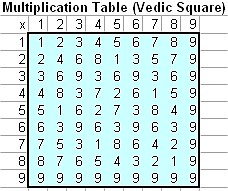
You have seen above the pattern of Multiplication table of digital roots. Now, how do you think of Division, Addition and Subtraction tables of digital roots? Will they have the same pattern or different pattern? Continue to read on the next section to find out


<Previous | Next | Contents>

Share and save this tutorial
Add to: Del.icio.us  Add to: Digg  Add to: StumbleUpon   Add to: Reddit   Add to: Slashdot   Add to: Technorati   Add to: Netscape   Add to: Newsvine   Add to: Mr. Wong Add to: Webnews Add to: Folkd Add to: Yigg Add to: Linkarena Add to: Simpy Add to: Furl Add to: Yahoo Add to: Google Add to: Blinklist Add to: Blogmarks Add to: Diigo Add to: Blinkbits Add to: Ma.Gnolia Information

These tutorial is copyrighted.

Preferable reference for this tutorial is

Teknomo, Kardi (2005). Digital Root. http:\\people.revoledu.com\kardi\tutorial\DigitSum\


© 2007 Kardi Teknomo. All Rights Reserved.
Designed by CNV Media