
<
Previous
|
Next
|
Contents
>
Generalized Mean
In the previous section, we have discussed two generalized means of Minkowski mean and Lehmer mean. However, the two means is not "general enough" because Minkowski mean does not have a specific p to represent Geometric mean while Lehmer mean does not have a specific p to indicate Quadratic mean. This lead to a question whether we have a general mean to represent all the four basic means (Arithmetic mean, Geometric mean, Harmonic Mean and Quadratic Mean).
Phillips (2000) suggests the following quasi-arithmetic generalized mean which has been available through the work of Andrey Kolmogorov in 1930 . The mean is quite general that it can cover arithmetic mean , quadratic mean , harmonic mean and geometric mean and many others. In fact, Kolmogorov Generalzed mean can also cover Minkowski mean as shown in the example below.
Instead of using a parameter, however, Kolmogorov generalized mean uses function and its inverse function to generate mean. Suppose we have a continuous monotonic function
 from positive real numbers to positive real number and the inverse function of
 exist, then we can make infinite number of means using
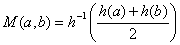
Extending the generalized mean to
 input numbers is straightforward.

I hope you remember the definition of inverse function that if
 then
then
 . Simple inverse function can be obtained by exchange
 and
and
 in the expression. Then the following are two properties of inverse function:


Example:
 , then
 , then we have
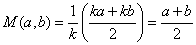 which is an
arithmetic mean
which is an
arithmetic mean
Example:
 , then
 , then we have
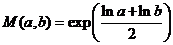 which can be simplified into
Geometric mean
by
which can be simplified into
Geometric mean
by
 Since
Since
 only accept positive values of x, Geometric mean also can accept positive values.
Example:
 , then
 , then we get
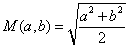 which is a
quadratic mean
which is a
quadratic mean
Example:
 , then
 , then we obtain
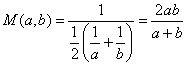 which is a
harmonic mean
which is a
harmonic mean
Example:
 , then
 , then we get
 which is
Minkowski mean
which is
Minkowski mean
Example:
 , then
 , then we obtain
 which is a Harmonic mean
Table below provides the summary of functions to relate Kolmogorov generalized mean and other means.
|
Name |
function |
Inverse function |
Mean of (a, b) |
|
Arithmetic Mean |
|
|
|
|
Geometric mean |
|
|
|
|
Harmonic mean |
|
|
|
|
Minkowski mean |
|
|
|
|
Quadratic mean |
|
|
|


<
Previous
|
Next
|
Contents
>
See also:
Minkowski mean
,
Lehmer mean
,
arithmetic mean
,
harmonic mean
,
geometric mean
,
quadratic mean
Rate this tutorial or give your comments about this tutorial
This tutorial is copyrighted .
Preferable reference for this tutorial is
Teknomo, Kardi (2015) Mean and Average. https:\\people.revoledu.com\kardi\tutorial\BasicMath\Average\