
<
Previous
|
Next
|
Contents
>
Memory of Adaptive Learning
So far, we have game with . The adaptive learning using histogram is simple and powerful. The learning algorithm, however, is only based on total number of user response. It has very short memory of what the user response aside from single previous response. In this section, we will generalize the learning algorithm by adding system memory.
Firstly, we must understand the meaning of system memory. A system with short memory tends to be affected by the most recent behavior of user input. This system has fast or fluctuated response because the output behavior is responding quickly to the change of the input. System with long memory has sluggish behavior. It does not response as speedily to the change of input behavior.
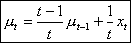
To add the long memory to our learning system, we remember the characteristics of time-average , which has long-term memory. The recursive formula to compute the time-average is given by:
 (A)
(A)
Notation
 is the time-average of measurement data
 . When the time
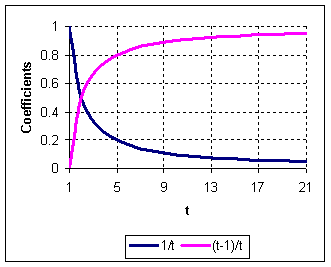
 is a natural number 1, 2, 3, 4 , the graphs of the coefficients
are plotted below:
is a natural number 1, 2, 3, 4 , the graphs of the coefficients
are plotted below:
Let us give a new notation
 then
then
 and the equation (A) can be written as
 (B)
(B)
In the time-average formulation, the value of
 is dynamically changing over time. Suppose we fix the value of
as a real number between zero and one inclusive (
is dynamically changing over time. Suppose we fix the value of
as a real number between zero and one inclusive (
 ) to represent the learning rate, and replacing the measurement value as probability distribution, we obtain
learning probability distribution. In the previous example
, we have acquired
Probability distribution of failure
) to represent the learning rate, and replacing the measurement value as probability distribution, we obtain
learning probability distribution. In the previous example
, we have acquired
Probability distribution of failure
 . This failure probability will serve as input to our learning probability distribution. Adjusting the notation of the equation (B) for probability distribution, we get what is called
learning formula (C) with single parameter
.
. This failure probability will serve as input to our learning probability distribution. Adjusting the notation of the equation (B) for probability distribution, we get what is called
learning formula (C) with single parameter
.
 (4)
(4)
The range of parameter
is
to produce correct result. Outside this range, the probability may be bigger than one or negative. When the parameter
is near to one, the updating of probability is small. Closer the value of
to zero, will produce change that is more sensitive. When

 . The update of learning probability distribution is only depending on the number of correct and wrong answers (as in the
previous example
). It has only short memory and do not have depending on the timing when it was answered. When
. The update of learning probability distribution is only depending on the number of correct and wrong answers (as in the
previous example
). It has only short memory and do not have depending on the timing when it was answered. When
 , the learning distribution is updated not only based on the
histogram of correct or wrong answers but also based on the timing to
answer it correctly. If
=
1
, the learning probability value never change and whatever user input, the computer will not learn anything.
, the learning distribution is updated not only based on the
histogram of correct or wrong answers but also based on the timing to
answer it correctly. If
=
1
, the learning probability value never change and whatever user input, the computer will not learn anything.
We can view the parameter
as a learning rate or learning sensitivity value. Sensitive value will make fluctuation change in the learning probability.
For example, single wrong answer will change the probability from 25%
to 55% or single correct answer may change from 25% to 10%. Less sensitive
value (i.e. learning rate
near to 1.0) represents the program that learn very slow. For
example, to change the learning probability from 20% to 21% demand the
user to answer correctly many times.
Another view of the parameter
is as the
rate to reach stability
. If the equilibrium
of the probability distribution exists, (i.e. user has constant learning
distribution), with sensitive parameter
, the updating probability can reach the equilibrium faster than
the insensitive parameter. Closer the parameter
is to one, the updating of probability is will be slower to reach
the equilibrium.
The
next section
we will discuss about the
numerical application
of the learning formula.
<
Previous
|
Next
|
Contents
>
These tutorial is copyrighted .
Preferable reference for this tutorial is
Teknomo, Kardi (2015) Learning Algorithm Tutorials. https:\\people.revoledu.com\kardi\ tutorial\Learning\