

Kendall Distance
Kendal distance measure disorder of ordinal variables by counting the minimum number of transposition of discordant pair. Discordant pair is adjacent pair digits on disorder-vectors that at least one digit does not match to the pattern-vector .
The algorithm to compute Kendal distance is to count the minimum number of operation Interchange or transposition of discordant pair:
- Select adjacent pair on disorder vector that at least one of digit does not match to the corresponding digit in pattern vector (= discordant pair).
- Interchange the order of the pair
The problem of Kendall distance computation is to find the minimum operation rather than the transposition operation itself.
Example:
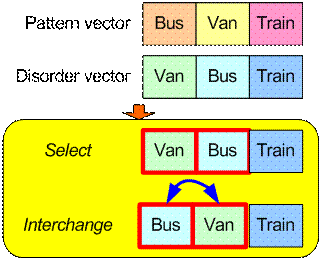
We have ask two persons, A and B about their preference on public transport and here is their ordering vector A = [Bus, Van, Train] and B =[Van, Bus, Train]
Suppose we use vector A = [Bus, Van, Train] as pattern-vector and vector B=[Van, Bus, Train] as disorder-vector. Diagram below shows only single interchange operation is needed to transform disorder-vector into pattern-vector. Thus, the Kendal distance of preference between A and B is 1
Example:
Suppose we have two judges (A and B) who give rank of importance over 6 products. The ranking vector is given as follow A=[1, 2, 3, 4, 5, 6] and B = [2, 5, 3, 1, 4, 6]. We want to measure Kendall distance between A and B
We set rank vector A as pattern-vector and vector B as disorder-vector. Our goal is to count the minimum number of steps of operation Interchange of discordant pair to make disorder-vector into pattern-vector. Diagram below show the steps. Since we count five number of interchange, thus the Kendall distance between A and B is 5.

See also: Cayley distance
Preferable reference for this tutorial is
Teknomo, Kardi (2015) Similarity Measurement. http:\people.revoledu.comkardi tutorialSimilarity